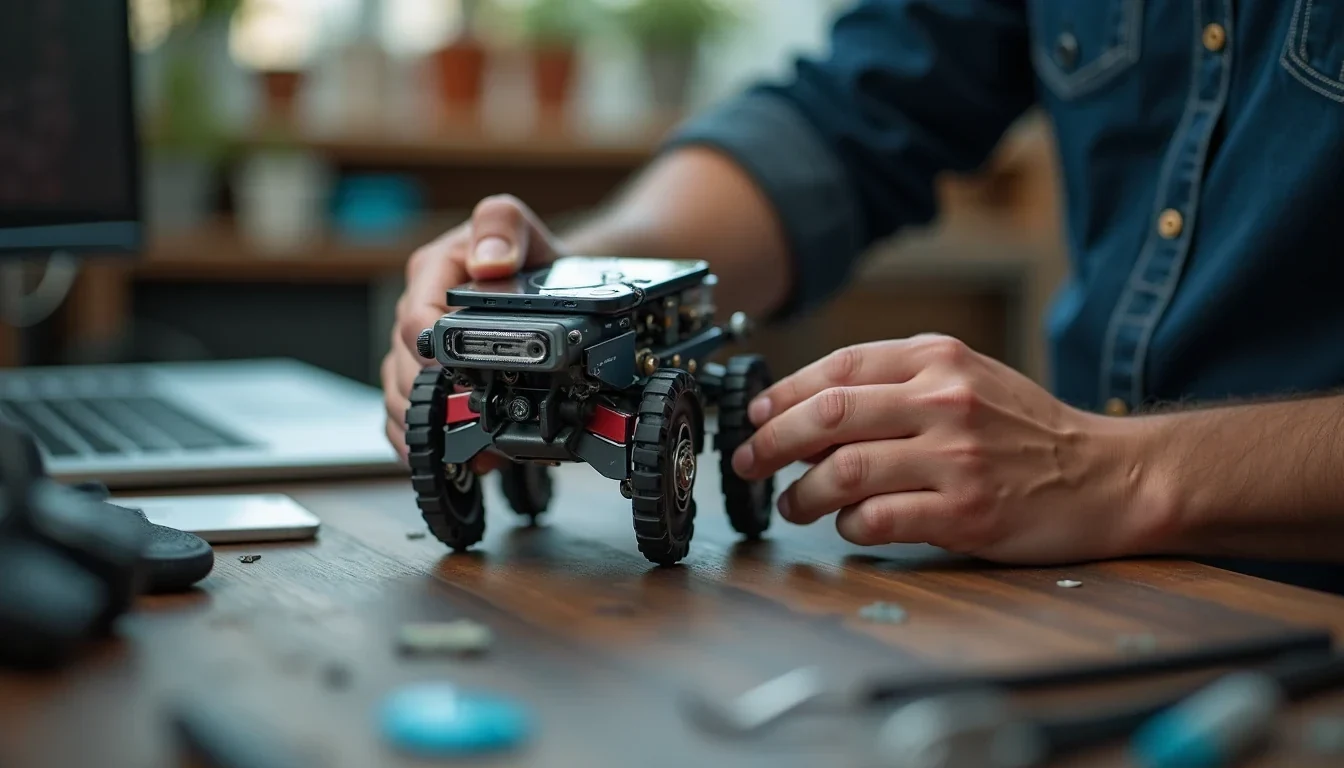
The drawer where old phones go to die has become the cheapest robotics lab in the country. A handset with a cracked screen, a battery that barely lasts half a day, or a camera that hunts for focus still works for this purpose. The processor, sensors, and Wi-Fi connection are what counts. Several open-source projects have worked out how to wire that dormant hardware into wheeled chassis and walking legs. Build costs sit well below what a proper robotics kit demands.
What the Projects Actually Do
UCLA’s RoMeLa laboratory built PhoneBot around a simple insight: a smartphone already carries the computer, camera, gyroscope, and wireless radio that a humanoid robot needs. Their design bolts an Android handset directly into the torso of a 13-motor bipedal walker, using the phone’s own sensors for balance and its camera for vision. The result walks, follows people, and rights itself from a face-down sprawl. The hardware bill runs to roughly $400 excluding the phone itself, placing it at the ambitious end of home builds.
Sesame moves in the opposite direction. Where PhoneBot reaches for humanoid complexity, the Sesame project shrinks everything down to four legs, eight small servos, and an ESP32 controller that talks to the phone over Wi-Fi. The code lives on GitHub under dorianborian/sesame-robot. The compact footprint suits builders working on crowded desks or with limited printer beds.
The project that has drawn the widest following is Smartphones into Robots. It offers Android and iOS control apps, advanced robotics workloads, and enough documentation that non-builders have reportedly followed the video guides through to a working machine. Unlike PhoneBot’s walking legs, OpenBot traditionally powers wheeled bodies built around microcontrollers such as the Arduino Nano.
Building the Body
OpenBot’s standard design calls for a 3D-printed chassis with specific phone mounts, bottom and top, supplied in STL and STEP formats. The default body needs a build plate of at least 240mm by 150mm, though a slim variant squeezes onto 220mm by 220mm at a 45-degree angle if the builder drops the bumpers. A modular glueable design by contributor @sloretz fits even tighter, at 150mm by 140mm. @Christos-Ps has published a blockier body with Lego-compatible top plate and extra internal room, demanding 221mm by 150mm. Cleaning of prints before assembly is advised.
For builders without printer access, the project lists several Arduino robot car kits that substitute for the custom chassis. The Perseids DIY Robot Smart Car Chassis Kit, the SZDoit 4WD Smart Metal Robot Car Chassis Kit, the Joy-it Robot Car Kit 01, and the generic Smart Car Kit 4WD Smart Robot Car Chassis Kit all work with a separate phone mount. Some builders have gone further off-script, fabricating chassis from wood, cardboard, or styrofoam. One such build by @custom-build-robots circulated on Slack as proof that precision aluminium extrusion is not mandatory.
The Electronics and the Choices
Two assembly paths exist. The DIY route uses an L298N motor driver, extensive wiring, and some comfort with electronics. It suits single builds and hobbyists who already own a soldering iron. The alternative is a custom PCB, which trades higher upfront effort in design or procurement for cleaner assembly and easier replication across multiple units.
The core component list is short: one Arduino Nano, four TT motors with tyres, three 18650 cells in a holder, one USB OTG cable, one spring or rubber band for tension, and a fistful of screws and Dupont cables. Optional additions include two speed sensors, one ultrasonic sensor for obstacle detection, an on-off switch, two 5mm orange LEDs, and one OLED display. LED builds wanting proper current limiting should add two 150-ohm resistors. A voltage divider calls for 20-kiloohm and 10-kiloohm resistors. PCB builds need five Micro JST PH 2.0 cables.
Component sourcing links cover Germany, the United States, and AliExpress. Local builders will recognise the pattern: order the specialised parts direct, buy the batteries and fasteners from any Johannesburg or Cape Town electronics supplier, and improvise the rest.
What the Phone Actually Brings
These projects center on a smartphone rather than a Raspberry Pi or dedicated board for reasons beyond cost. A discarded handset already integrates a multi-core processor, a GPU capable of machine learning inference, a camera, an accelerometer, a gyroscope, a magnetometer, GPS, and multiple radios. Replicating that stack from discrete components would multiply the budget and the physical volume. The phone also arrives with a mature software stack, touchscreen interface, and wireless update path that bare microcontrollers lack.
For education, this changes the learning experience. A student building around OpenBot Lite, the simplified educational variant, touches microcontroller programming, motor control, sensor fusion, 3D design, and basic fabrication in a single project. The smartphone layer adds computer vision and autonomous navigation that would otherwise require far more expensive hardware. The old handset becomes a curriculum.
The E-Waste Question
South African households accumulate an estimated millions of unused phones annually. Recycling rates remain low, and informal recovery often strips value destructively. These robotics projects do not solve that problem at scale, but they do offer one honest alternative for individual devices: extended useful life as a teaching tool or hobby machine rather than drawer clutter or improper disposal. The transformation is practical. A phone that can still boot, still see through its camera, and still balance itself in space has too much embedded capability to justify silence.
The builds are not effortless. They demand patience, some tool literacy, and the willingness to debug a wiring fault at 11 pm. But the documentation now exists in English, German, French, Spanish, Korean, and Simplified Chinese. The hardware lists are explicit. The video guides assume no prior experience. For anyone who has watched a child bored in a holiday program, or a student hungry for tangible engineering, or simply wanted to understand what a robot actually is by building one, the dormant phone in the drawer has stopped being waste and started being material.