
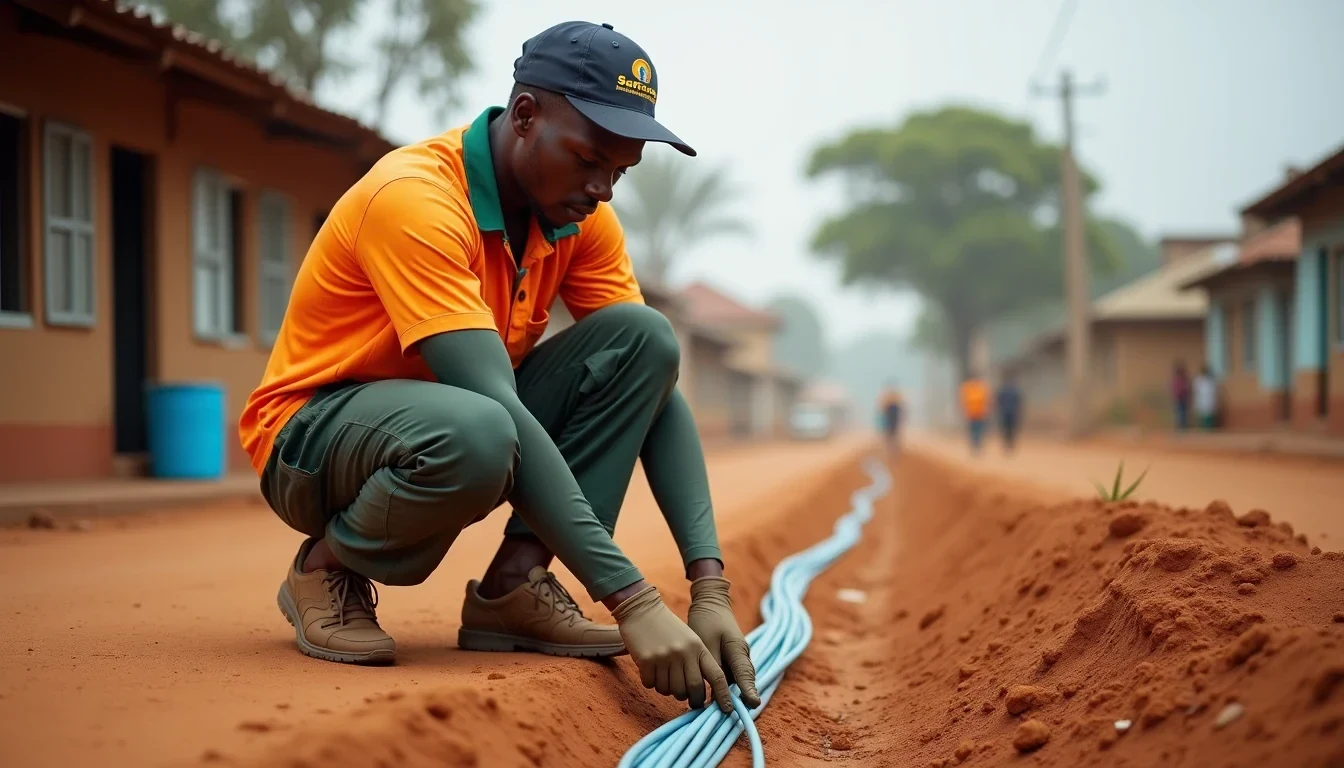
Kenya added nearly a million fixed internet subscriptions in twelve months. This jump rewires how an economy functions, and it happened while South Africa’s fibre market was still untangling wholesale pricing disputes and wondering why penetration in townships remains stubbornly low.
The numbers from Kenya’s Communications Authority tell a clear story. Fixed subscriptions reached 2.84 million, a 32.4% climb year-on-year. Fibre alone accounts for 1.57 million of those connections. Terrestrial wireless, the fixed-wireless access that South African operators talk about but have not pushed with comparable urgency, has crossed 1 million. Safaricom, the mobile giant that already dominates Kenyan money through M-Pesa, now holds 36.1% of the fixed market with over 1 million subscriptions. The company is becoming an infrastructure utility in the mould of old Eskom, but it actually builds.
What Kenya is building differently
Kenya’s market structure reveals the gap. Safaricom, Zuku, Jamii Telecommunications and Liquid Telecom are competing at the retail layer, building their own last-mile infrastructure rather than waiting for a wholesale open-access layer to materialise. South Africa’s fibre story, by contrast, has been dominated by fibre network operators like Vumatel, Openserve and Frogfoot, who build and then wholesale to internet service providers. The model has delivered coverage to affluent suburbs and urban cores, but it has also created friction. Every handoff between FNO and ISP adds margin, complexity, and delay. Kenya’s more vertically integrated operators appear to be moving faster, particularly in peri-urban areas where South African FNOs still struggle to make the numbers work.
The terrestrial wireless surge is important here. Kenya’s 1 million fixed-wireless connections are a deliberate parallel track, using 4G and early 5G to serve areas where trenching fibre is uneconomical or politically fraught. Rain and Telkom have played with fixed wireless in South Africa, but neither has scaled it with the consistency or pricing aggression that would make it a genuine alternative to fibre. Kenya’s regulatory environment, particularly around spectrum allocation and infrastructure permits, appears to have enabled faster deployment. South Africa’s Electronic Communications Act amendments have been pending for years, and the uncertainty shows in operator behaviour.
From telecom service to economic foundation
The shift in how Kenyan policymakers and businesses talk about connectivity is the deeper change. Fixed broadband is no longer framed as a consumer luxury or a telecom metric. It is discussed as the substrate for cloud computing, AI training and deployment, telemedicine, remote education, and the data centres that make all of it local. This is not aspirational language; it reflects the physical reality that moving large AI models or running real-time analytics across mobile networks is technically possible but economically absurd for anything beyond trivial use cases.
South Africa has the data centre footprint, the corporate demand, and the technical skills to make similar claims. It lacks last-mile ubiquity. A business in Sandton can provision cloud infrastructure in minutes. A business in Mdantsane or Gugulethu is still negotiating with multiple providers for uncertain speeds and reliability. The inequality is a competitive drag on the entire economy, because businesses outside the fibre footprint cannot participate in the same digital workflows as their urban counterparts.
The Safaricom factor and what it implies
Safaricom’s dominance deserves attention because it challenges a common South African assumption. The company has leveraged its mobile customer base, its brand trust, and its balance sheet to cross 1 million fixed subscriptions rapidly. Vodacom and MTN have similar assets in South Africa, yet neither has achieved comparable fixed penetration relative to market size. Part of the difference may be regulatory. Part may be strategic priority, with South African mobile operators still treating fixed as a sideline rather than a core growth engine. Part may simply be that Kenya’s less entrenched fixed-line legacy created space for new infrastructure thinking, where South Africa’s Telkom heritage produced institutional inertia that newer players are still working around.
The competitive dynamics also differ. Kenya’s Faiba, backed by Jamii Telecommunications, has pushed aggressive fibre pricing that forced market-wide responses. South Africa’s fibre pricing has compressed in some segments, but the wholesale model insulates FNOs from direct retail competition, which may slow price innovation.
What South Africa should watch
The policy lessons are specific and actionable. Kenya’s infrastructure permitting, particularly for rights-of-way and municipal trenching, appears to function faster than South Africa’s often fragmented local government processes. The national government has also been willing to support technology-neutral approaches, treating fixed wireless as a genuine complement to fibre rather than a competitor to be regulated separately. South Africa’s spectrum allocation history, by contrast, has been characterised by delays, litigation, and a persistent confusion between mobile and fixed wireless use cases.
The affordability question is where the comparison becomes uncomfortable. Kenya’s rapid subscription growth suggests that pricing has reached a threshold where middle-income households and small businesses can treat fixed internet as a standard utility expense. South Africa’s fixed broadband remains, for many, a significant budget decision, particularly once the promotional pricing expires and the full FNO plus ISP stack is revealed. The Competition Commission’s ongoing market inquiries into data pricing have focused heavily on mobile. The fixed market may deserve equivalent scrutiny, particularly the wholesale-to-retail margin structure.
The harder question
Kenya’s boom raises a question that South African policymakers and operators have been reluctant to confront directly. The next generation of economic growth, whether in AI, cloud services, or advanced digital business, requires networks that can move enormous data volumes with low latency and high reliability. Mobile networks, for all their coverage achievements, are not architected for this. South Africa has spent years optimising for mobile-first access, partly because it was faster and partly because it avoided the harder politics of fixed infrastructure deployment in unequal cities. Kenya’s numbers suggest that trade-off may now be a dead end. The countries that build the fixed layer now will have the economic substrate for the next decade. Those that delay will be running advanced digital economies on networks designed for smartphones.
The 32.4% growth figure is a benchmark against which South Africa’s fixed deployment pace, pricing trajectory, and policy responsiveness can now be measured. The measurement is not flattering.